Graphene-reinforced biopolymer blocks for CAD/CAM milling
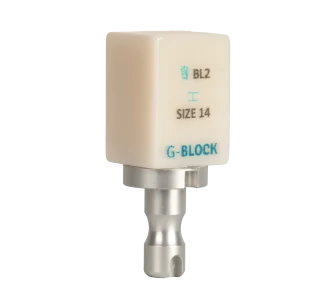
G-BLOCK: blocks of graphene nano-reinforced biopolymer
Thermoplastic polymer block based on graphene-doped polymethyl methacrylate, suitable for fabricating dental prostheses using CAD/CAM technology.
CAD/CAM technologyDeveloped with grapheneMetal-free
The material
What is G-BLOCK?
G-BLOCK is a graphene-reinforced biopolymer specifically designed for permanent dental structures, available in a range of shades that deliver natural aesthetics.
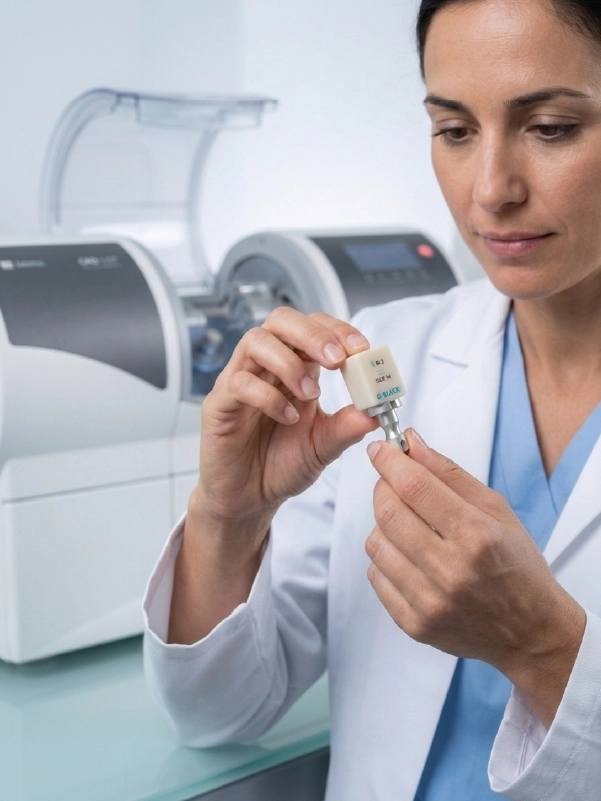
G-BLOCK blocks meet the requirements for prosthetic work with chairside and CAD/CAM technology, optimising working time and costs.
Technical specifications
Material properties
3200 ± 7 % MPa
Elastic modulus
UNE-EN ISO 20795-1:2013
140 ± 7 % MPa
Flexural strength
UNE-EN ISO 20795-1:2013
155 ± 5 MPa
Compressive strength
ISO 5833:2002
| Property | Value | Test standard |
|---|---|---|
| Elastic modulus | 3200 ± 7 % MPa | UNE-EN ISO 20795-1:2013 |
| Flexural strength | 140 ± 7 % MPa | UNE-EN ISO 20795-1:2013 |
| Surface hardness | 88 Shore D | ISO 48-4:2018 |
| Surface hardness | 19.5 KHN | ASTM E384 |
| Compressive strength | 155 ± 5 MPa | ISO 5833:2002 |
| Water absorption | 4 μg/mm³ | UNE-EN ISO 20795-1:2013 |
| Solubility | 0.5 μg/mm³ | UNE-EN ISO 20795-1:2013 |
| Residual monomer | < 0.004 % | UNE-EN ISO 20795-1:2013 |
What each property means
Higher modulus and elastic limit
Unlike conventional resins, the stresses generated during biting and chewing do not cause permanent deformation.
High resistance to deformation
The material’s stress limit prevents cracks and fractures from forming.
Low density
The block has a low density, resulting in a lightweight prosthesis.
Greater hardness
Higher than other acrylic resins used in dentistry.
Natural appearance
Appearance similar to the natural dentition.
Colour stability
Colour stability and a wide range that matches the natural dentition.
Chemically inert
The material is chemically inert.
Minimal absorption and monomer
Water absorption of 4 μg/mm³, solubility of 0.5 μg/mm³ and minimal residual monomer release (< 0.004 %).
Clinical applications
Indications
G-BLOCK blocks are intended for fabricating permanent and temporary prostheses such as anterior or posterior crowns and bridges on implants, inlays and veneers.

Single crowns

Bridges
*More than 2 pontics

Implant-supported prostheses

Bridges
*More than 2 pontics

Inlays

Veneers
Formats
Two sizes: 14 and 40 mm
G-BLOCK is a compact graphene-doped polymer block available in two sizes. Both are supplied with an integrated mandrel, in Multichroma format and in four shades.
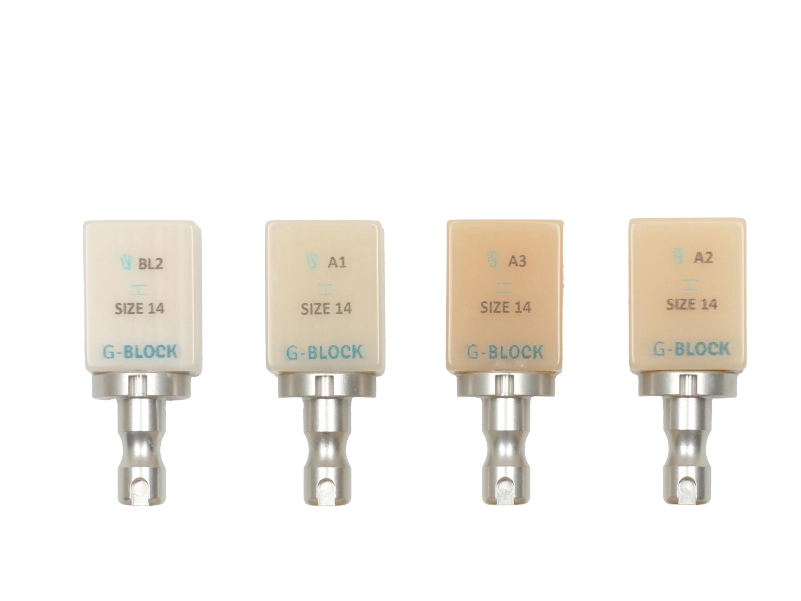
G-BLOCK SIZE 14
Compact block for single units, with an integrated metal mandrel.
| Name | G-BLOCK SIZE 14 mm |
| Overall dimensions | 18 ± 0.4 x 12 ± 0.4 x 14 ± 0.4 |
| Holder | Integrated metal mandrel |
| Format | Multichroma |
| Shades | BL2 · A1 · A2 · A3 |
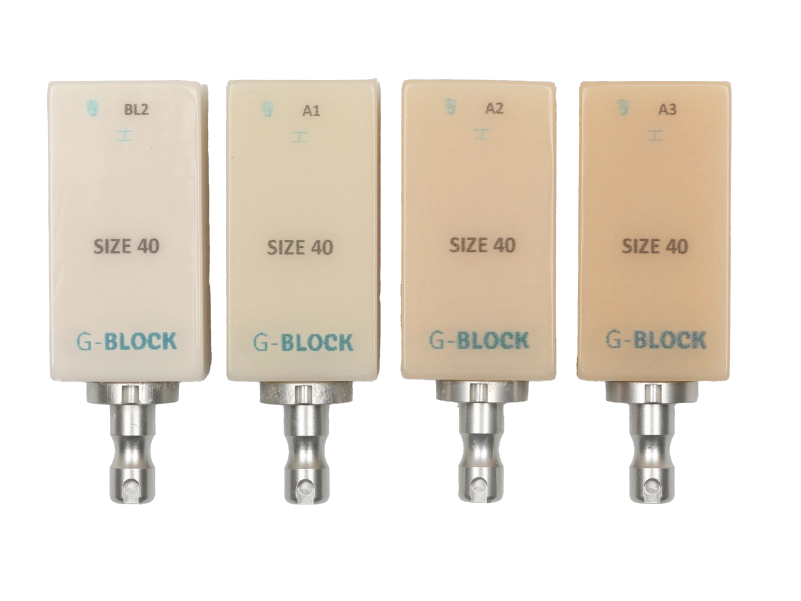
G-BLOCK SIZE 40
Block with a greater usable height, with the same mandrel and shade range.
| Name | G-BLOCK SIZE 40 mm |
| Overall dimensions | 39 ± 0.4 x 15.5 ± 0.4 x 19 ± 0.4 |
| Holder | Integrated metal mandrel |
| Format | Multichroma |
| Shades | BL2 · A1 · A2 · A3 |
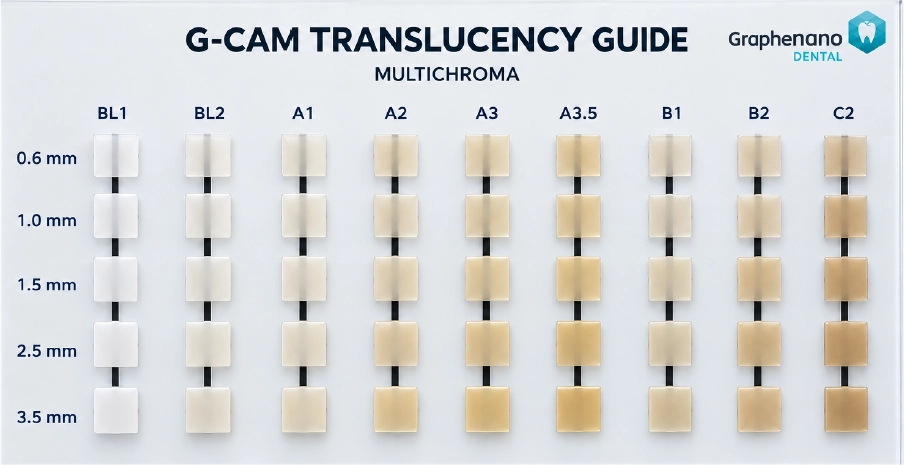
Shade range
Four shades, Multichroma format
The blocks come in Multichroma format in shades BL2, A1, A2 and A3, approximating the VITA guide.
For final selection, refer to the G-CAM Shade Guide.
BL2 A1 A2 A3
Workflow
From digital design to restoration
G-BLOCK fits into the standard CAD/CAM workflow with chairside technology. The work sequence is detailed in the following protocol.
01
Scanning and CAD design
Design the restoration in your usual software.
02
Block selection
Size and shade according to the case.
03
Positioning and milling
Mill the block in a compatible CAD/CAM system.
04
Separation and adjustment
Separate the piece, remove the connector point and adjust.
05
Finishing and polishing
Polish and characterise the prosthesis as required.
06
Cementation
Cementation protocol as described in the instructions for use, where applicable.
After-sales service
A technical department behind every case
Graphenano Dental has a technical support department that guides professionals as they adopt the material and in the day-to-day work of the laboratory and clinic.

Documentation
Downloads for professionals
Distribution
Where to buy G-BLOCK
🇺🇸 G-BLOCK is currently only sold in the US market.
Graphenano Dental ecosystem
Everything around G-BLOCK
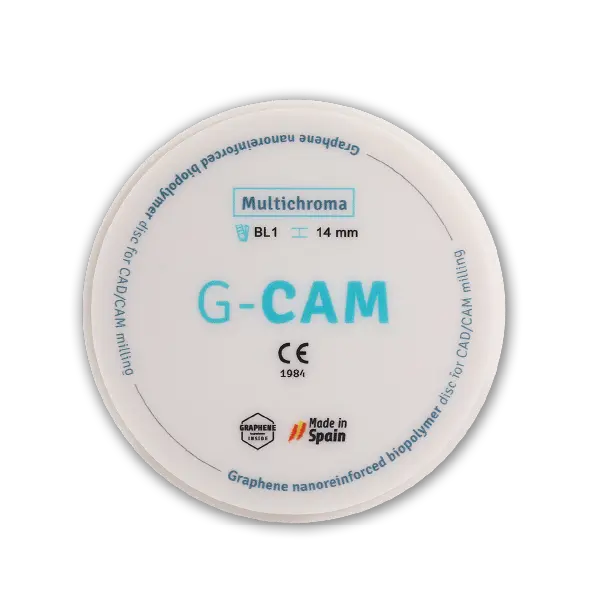
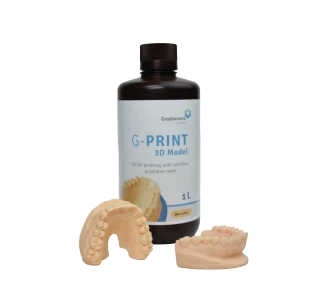
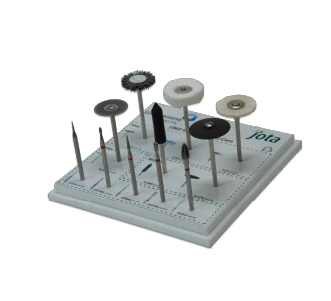
Polishing kit · Laboratory
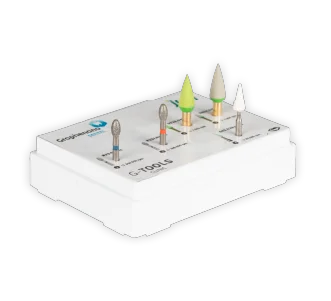
G-TOOLS
G-CAM polishing kit for an optimal finish in the laboratory.
Polishing kit · Clinic
G-TOOLS Clinic
Safe chairside adjustment and polishing after cementation.
Frequently asked questions
Answers to your questions about G-BLOCK
A graphene-doped biopolymer in block format, suitable for fabricating dental prostheses with CAD/CAM and chairside technology.
A polymethyl methacrylate base doped with graphene, an allotrope of carbon.
Implant-supported prostheses and permanent and temporary restorations: anterior or posterior crowns and bridges, inlays, onlays and veneers.
Yes. It is a biopolymer certified for permanent prostheses.
In two sizes: 14 and 40 mm, both with an integrated mandrel.
BL2, A1, A2 and A3, approximating the VITA guide. The G-CAM Shade Guide should be used for final selection.
No. It is a thermoplastic polymer that is milled and finished mechanically, with no sintering process.
It is compatible with any milling machine capable of milling blocks, as the mandrel has a universal mount.
Dual-cure resin-based cements are recommended; always read the instructions for the cement used.
It is currently FDA-cleared and available exclusively in the US market.
The same family of graphene nano-reinforced materials in two formats: G-BLOCK as a block and G-CAM as a disc.
Through authorised distributors or by contacting Graphenano Dental directly.